Friday, 21 August 2015

The Lady in White

The Lady in White is a type of female ghost reportedly to be seen in rural areas and in the country side. There are tales of these white ladies across the globe, the old myths have a common theme of betrayal in one form or another from a husband, boyfriend or fiancé. But they myths have slightly change to the more modern, where they are mostly tragic car accidents, these white ladies are said to be a harbingers of death, causing more car accidents so that others feel their pain at dieing do soon.


 Here are a small handful of legends from around the world:

Here in the U.K. there is an old myth said that the lady in white could be seen in either day or night in a house in which a member of the family would soon be dieing, they are said to be ancestors warning the family. 
 There is also the lady in white who haunts the "Beeford Straight" in east yorkshire. Motorists have reported her apparition running across the road. In one instance, a car crashed into a tree killing 6 people.

In Germany, a white woman was first reported to be seen in the Berliner Schloss in 1625 and sightings have been reported up until 1790. This castle is the residence of the kings of Prussia, so the Lady has been linked to a few historical figures such as the unfortunate widow Bertha of Rosenberg from Bohemia, overthrown by the heathen Perchta and the guilt-ridden countess Kunigunda of Orlamünde, who murdered her 2 children for getting in the way of a marriage she wanted.

In Philippines they are often used to convey horror and mystery to young children for storytelling. Sightings of White Ladies are common around the country, and usually every town and barrio has its own "White Lady" story.

Malta has 2 main myths the first being the White Lady of Mdina was killed by her lover after she was forced to marry another man. She usually appears to children under eight years old, heart-broken teenage boys, and elderly men. While she tells the children goodnight and bids them to return home, she advises the teenagers to "find another" or to join her and become a part of her "shadow" (her ghostly followers) as well as the elderly gentlemen. She is always seen after 8pm. The second myth has it that many years ago, a woman was to be married to a man she did not love. Her father told her that she must always do as her fiancé said since he was soon to be her husband. On the day of her wedding, she committed suicide by jumping off a balcony. That is how she got the name White Lady because she was wearing her wedding gown on the day of her death. She haunts the Verdala Palace and many people who attend the August moon ball confirm the haunting.


The Brazilian Lady in White is the ghost of a young woman who died of childbirth or violent causes. She appears as a pale woman in a long white dress or a sleeping gown, she will occasionally recount her misfortunes. The origins of the myth are not clear, it's proposed that the ghost is related to the violent deaths of young white women who were murdered by their fathers or husbands in an "honor" killing. The most frequent reasons for these honor killings were adultery (actual or suspected), denial of sex, or abuse.

In the USA most of (if not all) the lady in white legends are about young, beautiful women who have died in horrible car accidents and haunt the stretch of road or rough area of their deaths.

There are hundreds of more myths and many have inspired tv shows, movies and books. The lady in white is one of the most wide spread, well know haunting around.


Wednesday, 12 August 2015

Rusalka

A Rusalka is a type of water nymph, a female spirit in Slavic mythology and folklore.


The original "rusalka" was an name used by Pagan Slavic tribes, who linked them with fertility and did not consider rusalki evil. They came out of the water in the spring to transfer life-giving moisture to the fields and thus helped nurture the crops.

Things changed in the 19th century things shifted rusalka became an unquiet, dangerous being who is no longer alive and unclean spirits. They where young women's soul who had been drowned violently or committed suicide by drowning due to an unhappy marriage or had died near a river or a lake who must now live their remainder on earth as rusalka, haunting that waterway. They where also normally red haired, a connotation that might have come with the Orthodox faith sometime around late 15th century, they often aroused suspicion in traditional Russian societies as being bewitched.


.A rusalka's main purpose is to lure young men into the depths of said waterways where she would entangle their feet with her long red hair and submerge them, her body would instantly become very slippery and not allow the victim to cling on to her body in order to reach the surface. They where seduced by either her looks or her voice, a rusalka is generally considered to represent universal beauty, therefore is highly feared yet respected in Slavic culture.

During the Rusalka Week (in early June), they are believed to be their most dangerous, this is when they able to leave their water ways to climb trees, sit in the branches at nigh and sing songs, sit on docks with only submerged feet and comb their hair, or even join other rusalki in circle dances in the field. Swimming is strictly forbidden during this time. A common feature of the celebration of Rusalnaya was the ritual banishment or burial of the rusalki at the end of the week, which remained until the 1930's.

Apart from all this, the undead rusalka is not invariably malevolent, and will be allowed to die in peace if her death is avenged.


Wednesday, 5 August 2015

Sirens

This week we are looking at the Greek sirens, who are often lumped together with mermaids and naiads.

 The Sirens (Greek singular: Σειρήν Seirēn;  Greek plural: Σειρῆνες Seirēnes) were dangerous yet beautiful creatures, who lured nearby sailors with their enchanting music and voices to shipwreck on the rocky coast of their island many writers have implied that the Sirens were cannibals as well. Sirens were believed to look like women and birds in many different ways, from early Greece that had them depicted as birds with large women's heads, bird feathers and scaly feet, later moving on to women having bird legs, with or without wings or tiny sparrows with women's faces and then again changed being seductive women not only with their voices but bodies as well. Roman poets placed them on some small islands called Sirenum scopuli. sometimes on Cape Pelorum and at others in the islands known as the Sirenuse, near Paestum, or in Capreae. All such locations were surrounded by cliffs and rocks.

Although they lured mariners, the Greeks portrayed the Sirens in their "meadow starred with flowers" and not as sea deities. When the Sirens were given a name of their own, they were considered the daughters of the river god Achelous, fathered upon Terpsichore, Melpomene, Sterope, or Chthon (the Earth). Roman writers linked the Sirens more closely to the sea, as daughters of Phorcys.


The Sirens were called the Muses of the lower world, although in one myth they are challenged to a singing contest with the muses, losing all their feathers where plucked and the muses wore them like crowns. Horrified by losing they plunged into the sea never to be heard from again. It wasn't their only so called down fall some post-Homeric authors state that the Sirens were fated to die if someone heard their singing and escaped them but according to Hyginus, sirens were fated to live only until the mortals who heard their songs were able to pass by them. There have been a few myths featuring the sirens.

The term "siren song" refers to an appeal that is hard to resist but that, if heeded, will lead to a bad conclusion. It was also said that they sang to the soul and not the flesh making it easier to call people to them.


According to Ovid, the Sirens were the companions of young Persephone. They were given wings by Demeter to search for Persephone when she was abducted. However, the Fabulae of Hyginus has Demeter cursing the Sirens to forever be half bird half women for failing to intervene in the abduction of Persephone, although some say that it was a reward asked by the sirens to be turned so.
There is one so-called "Siren of Canosa" from Italy was said to accompany the dead among grave goods in a burial. She appeared to have some psychopomp characteristics, guiding the dead on the after-life journey. The cast terracotta figure bears traces of its original white pigment. The woman bears the feet, wings and tail of a bird. The sculpture is conserved in the National Archaeological Museum of Spain, in Madrid.

Although the sirens are pagan when Christianity came along they started to adopt them for their own image of bad temptation. The Early Christian euhemerist interuprited the myth of the sirens to be  they prostitutes who led travelers down to poverty and were said to impose shipwreck on them. They had wings and claws because Love flies and wounds. They are said to have stayed in the waves because a wave created Venus.

Their number is variously reported as between two and five:
 Aglaope, Peisinoe, Thelxiope and Molpe all daughters of Achelous and Melpomene
 Leucosia  Her name was given to the island opposite to the Sirenuss cape. Her body was found on the shore of Poseidonia.
 Ligeia She was found ashore of Terine in Bruttium.
Parthenope  Her tomb was presented in Naples and called "constraction of sirens" 


Sirens weren't the only ones in the world with this profession the theme of perilous mythical female creatures seeking to seduce men with their beautiful singing is repeated in the Danish ballad known as "Elvehøj", in which the singers are Elves.


Wednesday, 29 July 2015

The Naiads.


While researching the merfolk I came across many different sea myth creatures (a lot of which I knew about already), so I thought I would explore the water world a bit more ...

The naiads (Ancient Greek: Ναϊάδες) are where a fresh water nymph, living in rivers, fountains, lakes, springs and marshes. They were immortal (although some sources say they where on long lived), minor divinities who were invited to attend the assemblies of the gods on Mount Olympus.


 The naiads weren't bound to their rivers or lakes, the Greeks believed that all the water of the world was connected by deep rivers under the earth, so although their spirits where bound to their springs they could move around, but if their water source dried up then they would die too.

They, along with Artemis, where seen as the divine nurses of the young, and the protectors of girls and maidens, overseeing their safe passage into adulthood.They were often the object of archaic local cults, worshipped as essential to humans. Boys and girls at coming-of-age ceremonies dedicated their childish locks to the local naiad of the spring. In places like Lerna their waters' ritual cleansings were credited with magical medical properties. Animals were ritually drowned there.  They where also known for telling the future and often foretelling humans their destiny.


Those who possessed waters with some special property (or which were believed to have some special property), often had proper cults and shrines established in their honour. Examples of these include the Anigrides of Elis whose waters were believed to cure disease, and the Nymphs of Helikon and Delphoi whose waters were thought to bestow poetical and prophetic inspiration respectively. They often gave their names to towns, cities and islands, and as such were most likely regarded as the goddess-protectors of the community's water supply.

The Naiades of the rivers and marshes were attendant-nymphai of their River-God fathers. A few of these Nymphai were called goddesses of their own small tributary river, but for the most part they were rarely mentioned as individuals or received cult status, not like the naiads of springs and fountains. Although they aren't necessarily goddesses they where the nurses of the other gods including Dionysos by the Lamides and Naxian Nymphs, and Hera by the Asterionides. Others were found in the retinues of gods, such as the Naiades Bakkhai in the train of Dionysos, and Artemis' band of Amnisiades.


Although they where seen as calm serine beings, just like water they could be dangerous, Hylas of the Argo's crew was lost when he was taken by naiads fascinated by his beauty. and extremely jealous.

There are different types of naiads and each one had their own names.
 Crinaeae (fountains)
Eleionomae (marshes)
Limnades or Limnatides (lakes)
Pegaeae (springs)
Potameides (rivers)

There are many tales of individual naiads, here are a few: Aba, Bateia, Creusa, Lara, Moria, Orseis, Polyxo and Tiasa.


Wednesday, 22 July 2015

The Merfolk.

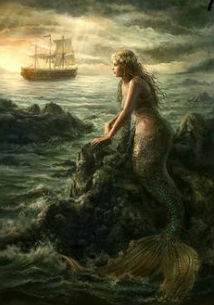
Everyone knows about Mermaids, sea creatures that are half human half fish, the tales of the merfolk have always been around especially when us humans started exploring the open waters, but there's a lot more to them then sitting pretty on a rock, brushing their hair and singing.


 There are many different names for mermaids (mer meaning sea and maid is woman) it all depends on where you are in the world. The Irish is Merrow, Scottish go by Ceasg (although this is more for the fresh water folk) The Isle of Man calls them Ben-Varrey and the Philippine folklore goes by Sirena and Siyokay to name but a few.
 Contrary to the belief mermaids aren't just for the big blue but also like fresh water bodies like lakes like in European folklore tell of the fresh water mermaids called Melusine, sometimes depicted with 2 fish tails or sometimes a serpents tail (this is where Star Bucks gets it logo). But they can also be found in the odd swamp or bog.

The first every written down record of the merfolk was the ancient Babylonian god Oannes. He was often depicted as having a beard and crown and supporting the half human half fish body, but it is said that he had both a human and fish body so that he could live and blend better in both worlds.
 Mermen aren't as popular or as well known as their female counterparts but they sit have a foot hold in the lore.
 It depend where you go or what time period the stories are from on how the mermen acted or looked like, mostly they where to be said to be very ugly with big beards, tempremental and staying away from humans as much as possible, they could also sink a ship by calling on huge storms, they could also attack humans (when the mood so took them) by singing just like the mermaids.
 But in other places like Finland they where powerful and handsome, wise teachers and magic wielding they could also cure illness, lift curses and brew potions.
 The most well know merman has to be Triton, son of Poseidon and Amphritrite, neither of them where merfolk themselves but both could live on land and in the sea. He was also known as the trumpeter of the sea for his use of a conch shell.


The first female story to appear was in Assyria 1000BC. It was the goddess Atargatis, mother of the Assyrian queen Semiramis. The goddess was in love with a human sheppard but when she unintentionally killed him she jumped into the lake in shame and tried to take on the form of a fish, the water wouldn't conseal her divine beauty and so she became a mermaid. Although the first renditions of her was of  a fish with a human head and arms, similar to the Babylonian god Ea. The Greeks took her as Derketo. 
Normally mermaids are roughly the same across the board with few differences. 
 In British folklore they are a bad omen (as they generally are across the world) both foretelling disaster and provoking it. They would lure ships over by singing them onto the rocks or in passing telling the ships crew that they would never see land again. They were also a warning for rough weather ahead. Some people said they where monstrous creatures some being as big as 2000 feet (610 meters).
 China added on to say that their tears when shed would turn into pearls, and the Javanese people believe that the southern beach in Java is home to the mermaid queen Nyi Roro Kidul. 
A popular Greek legend turned Alexander the Great's sister, Thessalonike, into a mermaid after her death, living in the Aegean. She would ask the sailors on any ship she would encounter only one question: "Is King Alexander alive?" it would end badly if she was told he was no longer king.
 But there are places in Europe that they are seen as kind and helpful even trading with the villages along the coast.


 The stories had to come from some where and not only from the Gods that many people worshiped (and still worship several modern religions, including Hinduism and Candomblé (an Afro-Brazilian belief), worship mermaid goddesses to this day). There where many sightings of these very beautiful but dangerous creatures. 
In 1493, sailing off the coast of Hispaniola, Columbus reported seeing three "female forms" which "rose high out of the sea, but were not as beautiful as they are represented". Another story, from 1830 in Scotland, said that a young boy killed a mermaid by throwing rocks at it; the creature looked like a child of about 3 or 4, but had a salmon's tail instead of legs. The villagers are said to have buried it in a coffin, though there seems to be no historical evidence of this fishy tale. 
 Even Blackbeard an English pirate, records that he instructed his crew on several voyages to steer away from charted waters which he called "enchanted" for fear of merfolk or mermaids, which Blackbeard himself and members of his crew reported seeing.
Modern mermaid reports are very rare, but they do occur; for example, news reports in 2009 claimed that a mermaid had seen sighted off the coast of Israel in the town of Kiryat Yam. They even set a reward for proof that there was one. 
 There was also a fake documentary called Mermaid on Animal Planet that sent everyone into a spin thinking it was real.
 But where there are sightings there's going to be people who take advantage and make money from the masses. In the middle of the 17th century, John Tradescant the elder created a wunderkammer (called Tradescant's Ark) in which he displayed, among other things, a "mermaid's hand" and  in the 19th century, P. T. Barnum displayed a taxidermal hoax called the Fiji mermaid in his museum.

There are mean explanations for what people may be seeing out there, could there really be creatures in the depths or just sea things that look kind of like what the merfolk are. Many people have speculated and the ones that don't believe that they are real have come up with things that explain it and put it down the early men's minds not understanding what they saw, like Sirenia is an order of fully aquatic, herbivorous mammals that inhabit rivers, estuaries, coastal marine waters, swamps and marine wetlands. Sirenians, including manatees and dugongs, possess major aquatic adaptations: arms used for steering, a paddle used for propulsion, and remnants of hind limbs (legs) in the form of two small bones floating deep in the muscle. mariners before the mid-nineteenth century referred to them as mermaids.
Sirenomelia, also called "mermaid syndrome", is a rare congenital disorder in which a child is born with his or her legs fused together and small genitalia. This condition is about as rare as conjoined twins, affecting one out of every 100,000 live births[5] and is usually fatal within a day or two of birth because of kidney and bladder complications. Four survivors were known as of July 2003
Due to their vaguely anthropomorphic shape, dried skates have long been described as mermaids. Often their appearance is deliberately modified to make them look even more human.
In some of the legends of the Pacific Islands, it is said that human beings are descended from the merfolk. Somewhere along the way we developed legs and lost our tails, maybe that's why we have such a fascination with the ocean and what in it.

 But whether they are real or not the merfolk have a fascination of the mystical sea creatures with stories like Hans Christian Andersen's fairy tale, The Little Mermaid, first published in 1837. In this version there isn't a happy ending (unlike the Disney adaptation). This sparked a huge interest and even got a world-famous statue of the Little Mermaid, in Copenhagen, Denmark since August 1913, with copies in 13 other locations around the world – almost half of them in North America.
 Some places even believed that we are descended from the merfolk but at some point along the way lost our tails and the ability to live underwater, perhaps that's were our fascination with the ocean and the creatures that live in it came from.


What's this all about?

The Mythological Gospel is all about everything myth, legend, supernatural and paranormal. Basically anything that goes bump in the night, but also the magical and mystical.